

[ad_1]
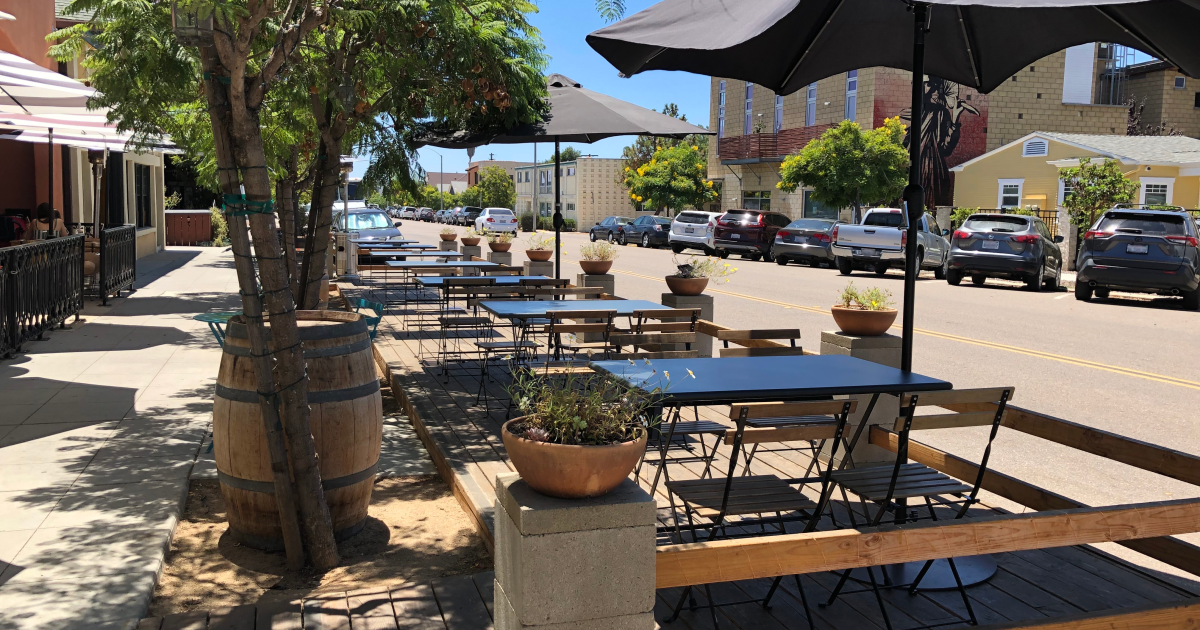
The San Diego City Council on Tuesday tentatively approved the Spaces as Places program, which allows permanent al fresco dining and other amenities in spaces previously viewed as temporary during the COVID-19 pandemic.
According to the city, Spaces as Places enables outdoor areas for dining, walking, cycling and other activities and offers opportunities for temporary outdoor structures that become permanent installations.
RELATED: Weeks after the order to take it off, the Chula Vista Brewery gets their parklet back
The council voted 6-2 in favor of the program while Sean Elo-Rivera and Joe LaCava opposed it, while Chris Cate was absent.
The ordinance originally proposed limited “streets” or outdoor restaurants on streets with a speed limit of 25 miles per hour or less. Six councilors voted to amend this ordinance to allow streetaries on roads with restrictions of up to 30 mph. Elo-Rivera and LaCava said they wanted to keep the limit at 25 mph or less.
RELATED: Michelin Guide Honors 5 San Diego Restaurants
Mayor Todd Gloria, who originally proposed a permanent al fresco dining program, said he was proud that the city council approved Spaces as Places.
“Spaces as Places also allows entire streets to be closed to create boardwalks and will ensure long-term options that are safe, equitable and accessible for all San Diegans,” said Gloria.
Earlier this year, city officials began collecting feedback from community members and business owners about the benefits of the program. The employees then worked out location, design and approval requirements for the further use of the outdoor areas. They also designed a manual for streetaries, active sidewalks, boardwalks, and al fresco dining on private properties.
According to Gloria’s office, Spaces as Places is targeting businesses in traditionally underserved communities to ensure that investments in outdoor restaurants and improvements for bicycles and pedestrians are evenly distributed across the city.
Urban Planning Director Mike Hansen said that since the pandemic began, “we are seeing more people spending time outdoors and wanting to continue to spend time with their friends and family outdoors.”
“We pride ourselves on having a program that will empower and improve our neighborhoods by providing more opportunities for people to socialize in safe and comfortable outdoor spaces while supporting our city’s economy,” said Hansen.
30 days after the city council’s second reading of the ordinance, which is expected in November, the “Spaces as Places” program for entrepreneurs comes into force. Before the program can come into effect in coastal communities, according to Gloria’s office, it must also be approved by the state coastal commission.
On August 4, 2020, the council approved an emergency ordinance that allows temporary outdoor business operations as an emergency response to the COVID-19 pandemic. This allowed businesses to have al fresco dining within the public driveway to enable catering establishments to operate when indoor operations were restricted due to public health orders.
In May, the city council extended the effort until July 13, 2022. Spaces as Places was designed by the city’s planning department and was intended to convert temporary spaces from an emergency response to a permanent program with set design and safety standards.
During Tuesday’s session, Councilor Mari von Wilpert described allowing outdoor dining as “one of the silver linings we saw in the terrible ordeal of the COVID pandemic”.
Her colleague Stephen Whitburn said 2020 and this year have been “unexpectedly difficult for our small businesses and restaurants,” in part because of limited capacity laws.
“With this regulation, we continue to find creative solutions,” said Whitburn, who added with the proposed changes, “we see a better and fairer regulation.”
Spaces as Places has also been lauded by several business and civic groups, including the California Restaurant Association, the Downtown San Diego Partnership, and the San Diego County Bicycle Coalition.
[ad_2]
Source link
